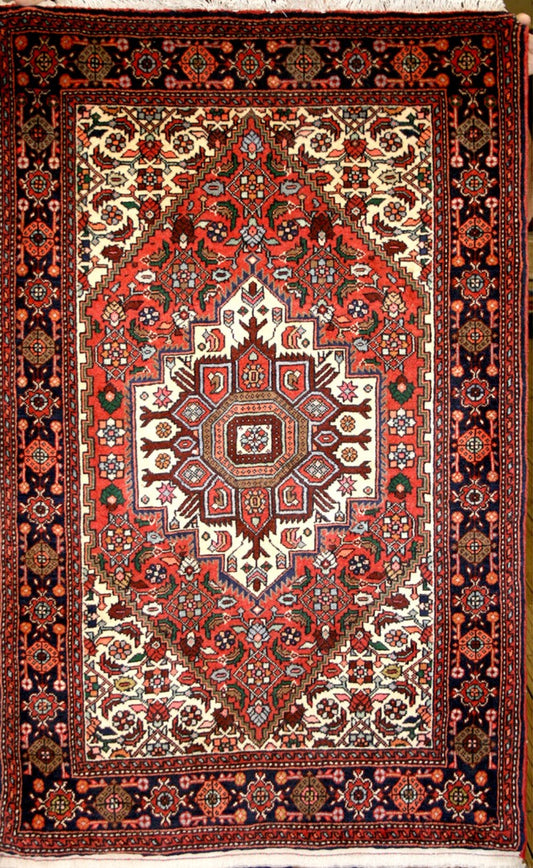
Exploring Gholtogh: A Lesser-Known Persian Village Rug
Gholtogh, also written as Goltogh, Gholtoogh or Qoltogh, is a lesser-known Persian rug type associated with north-western Iran, particularly the Zanjan region and the wider Bijar weaving sphere. Although sometimes discussed alongside Bijar rugs, Gholtogh rugs have their own regional character and should not simply be treated as Bijar pieces.
Understanding the Character of Gholtogh Rugs
Gholtogh rugs are often valued for their firm structure, compact handle and distinctive village-weaving character. Many examples are woven with wool pile on cotton foundations, with designs that tend towards geometric drawing, medallion layouts, angular floral motifs and regional border patterns. Colours can vary, but deeper reds, blues, orange tones and occasional turquoise accents are often associated with the type.
The Regional Connection: Gholtogh and Bijar
Gholtogh weaving is often linked to Bijar because of its geographical and cultural connections, as well as similarities in firmness, density and certain design habits. However, Gholtogh appears to have developed as a more modest village production rather than a major workshop tradition. Its history is less fully documented than better-known Persian rug centres, which makes careful identification important.